
“The ‘true value’ of getting your materials handling equipment and supplier right”
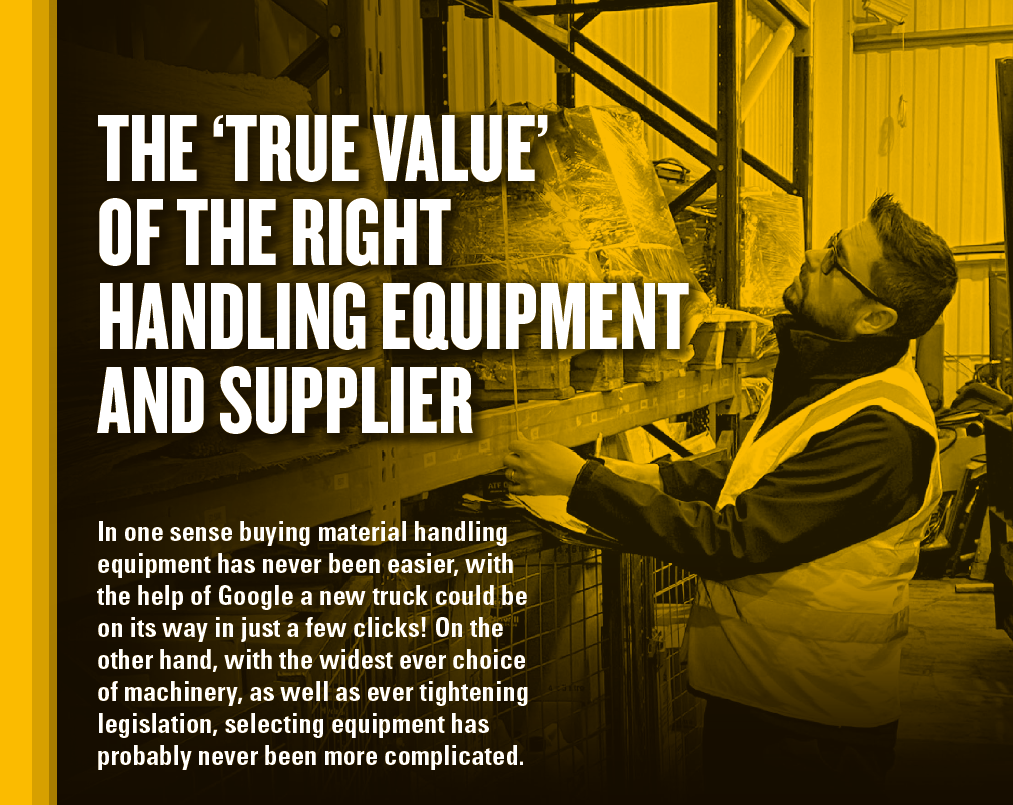
In one sense buying a lift truck, or any other kind of material handling equipment (MHE), has never been easier. Indeed, with the help of Google a new machine could be on its way to you in just a few clicks.
On the other hand, when you consider that today there is the widest ever choice of equipment, specifications, power sources, options… as well as ever tightening legislation, increasing environmental concerns, health & safety priorities, economic pressures… selecting equipment has probably never been more complicated.
The successful navigation of all these variables, while daunting, does have the potential to deliver a handling solution to a business that is a far better fit for its needs than has ever been possible before.
And it is at this point where the difference between equipment that is nearly right and equipment that is exactly right can deliver the biggest wins for all businesses and unlock ‘true value’.
This is also where the idea of buying a truck online, or without taking professional advice, starts to seem a lot less attractive.
The biggest variable of them all is actually the operational application and the customer site itself. Whether this is one location or multiple, the combination of material flow factors, and the nature of the handling environment, is often the biggest area of opportunity to realise optimisation and value from a handling fleet. It is also a critical area for health and safety, as well as environmental considerations. Yet, almost unbelievably, this is one of the most overlooked areas by equipment users.
Consulting an experienced material handling specialist can bring enormous benefits in these areas, and is absolutely essential from a safety perspective.
At Impact Handling, for example, we have vast experience and practical data from managing handling equipment for 1000’s of customers across the UK. Our active direct rental fleet alone includes over 6,500 units and we additionally service and maintain customer-owned fleets containing another 15,000+ machines, covering all major brands and specialist handling equipment. These machines are deployed across many diverse sectors and all nature of sites – meaning there aren’t many scenarios we haven’t seen.
This real world experience has given us a deep practical working knowledge which our customers, both old and new, are able to benefit from – Helping them to identify the perfect solution for their needs and bringing better value to their operation.
We believe so strongly that professional site surveys are essential to any handling equipment purchase that we provide these as an entirely complimentary service to all our customers.
Always be open to a better solution!
Once the handling environment and application have been professionally assessed, attention can be turned to the choice of equipment itself. It is important that this choice is led by the customer’s priorities. Do not allow an equipment supplier to restrict the range of choice – be that power source, the handling capacity or the ability to fully customise the equipment to exactly fit the need.
Although statistically, the current momentum is clearly towards electric as the power source of choice, 44% of all new machines sold are still internal combustion (IC) powered, based on the 2023 UK Materials Handling Association market data.
It is worth keeping an open mind and appraising all options, as not every business is ready, willing or able to make the change to electric. The biggest hurdle often proving to be power supply restrictions.
If that is the case for your operation, don’t be afraid to embrace the new generation of diesel and gas powered machines. The technology has made significant strides, with the current stage V generation of engines meeting all of the current stringent emission legislations, as well as delivering exceptional fuel efficiency. The operational performance benefits of IC over electric can also prove beneficial in many site environments.
While electric machines do incur an initial price premium, for those ready to make the switch they also generally offer a lower Total Cost of ownership (TCO), thanks primarily to the fuel savings.
Electric truck technology continues to advance at remarkable speed and previous limitations are improving every day. The battery changeover process, for example, has been refined to the point where it can take as little as five minutes on the latest CAT machines.
Do also keep an open mind about the different battery technologies – Lithium-ion and Lead Acid – both of which remain highly relevant depending on the application and environment.
Richard Root, National Sales Manager at Impact Handling notes: “Although 90% of the electric truck conversation is about Lithium-ion, it still only represents around 20% of sales”. This fact is supported by the UK Materials Handling Association, whose 2023 figures show that 72% of all all new electric equipment sales are specified with Lead Acid batteries. The largest uptake of Lithium Ion batteries being in the powered pallet truck segment, where the split is approaching 50/50.
Don’t lose sight of what really matters
When considering new equipment it is very easy to overlook the factors that are the most critical to the business. Namely reliability and up-time.
Many operations will grind to a halt if the material being handled cannot be moved, or if the goods cannot be loaded. And the cost of this interruption can be significant.
This is why the choice of service provider and the quality of their equipment may just be the single most important MHE decisions you make. So look carefully at the geographical reach of your supplier’s service network and at their response time.
At Impact we have over 250 dedicated service engineers, who are deployed as a mobile response force, equipped with state-of-the-art service vans, carrying stock of all common service parts. Collectively this team provides nationwide coverage and industry leading response times. This is supported by regional depots which hold comprehensive parts inventories, all configured for rapid delivery.
Make sure you carefully appraise your supplier and make sure that they can respond to your needs and locations.
Try to choose a supplier for the long term. Avoid those who are just looking for a one-off sale, they will not be motivated by your best interests.
As Richard Root from Impact adds: “A common mistake we see is the overestimation of the capacity of a truck required for a given application. This results in the customer paying more than they need for a machine that will subsequently cost more to run and maintain, with no practical benefit to the business.”
Flexibility is your friend
We are living in a fast moving world and that demands a fleet that can respond to, and keep up with, that rate of change. Flexibility, in all its forms, from your MHE supplier has never been more important.
The ability to change your fleet during the term of your agreement is a good example, as Richard Root explains:
“The benfits of our flexibility were really highlighted during the COVID pandemic, when we were able to support customers whose needs changed dramatically, almost overnight. It allowed them to rapidly change the profile of their fleet to meet their new needs, without cost penalty.”
A flexible supplier will also give you more options when you come to plan your fleet, as Richard continues:
“A good supplier will be able to offer you a wide range of new equipment from high quality brands. They should also carry a strong fleet of short term hire machines to supplement the core fleet as and when required AND at short notice. At Impact we run a fully approved refurbished programme too, meaning we take the best equipment coming out of contract and refurbish it back to its original specification. Giving customers yet another purchase option.”
Financial flexibility is also an important consideration. Balancing long term rental contracts versus outright purchase with maintenance agreements, or even hybrid models can provide yet more areas for a business to realise economies and savings. Self funding suppliers, like Impact, can offer greater financing flexibility too, so be careful to do your homework here as well.
So, in summary, there is more to choosing the right equipment than you might at first think. However, the right supplier can do most of the leg work for you, without any additional charge, and the effort will be well worthwhile.
Approached correctly, the outcome has the potential to deliver benefits to all areas of your fleet, operation and business, and to do so while reducing costs – now that’s ’True Value’.
Contact us now so we can help you identify the perfect solution for your needs – sales@impact-handling.com


